
A hotel bathroom should be inviting for guests and easy to clean. In a residence, the spaces often require compact solutions. In the locker rooms of a sports facility, frequent use and privacy become key considerations.
For those who manufacture, sell, or install shower enclosures, these requirements translate into specific decisions: the configuration of the openings, the characteristics of the glass, the manufacturing processes, and compatibility with the hardware.
Vetreria Dal Bo’ manufactures shower enclosure glass for installers, manufacturers, and retailers, tailoring their craftsmanship to meet the needs of their projects. The starting point is understanding how the shower will be used and what requirements it must meet.
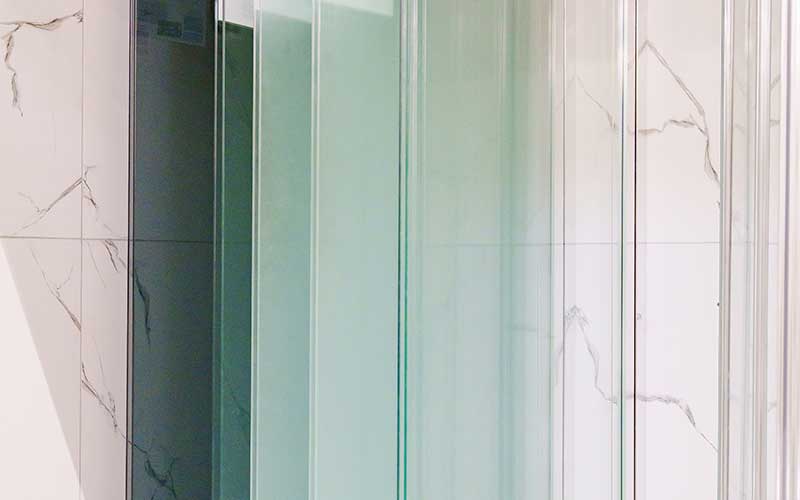
Which shower enclosures should you choose for hotels and residences?
There is no single “best” configuration. The choice depends on the bathroom’s layout, the available access space, and the expected maintenance requirements.
Fixed shower walls and walk-in showers
A fixed glass partition defines the shower area while maintaining visual continuity with the rest of the bathroom. It’s an appealing solution for designs that emphasize bright spaces and clean lines.
The absence of a door reduces the number of moving parts to manage, but requires careful planning: the dimensions of the wall, the position of the showerhead, and the depth of the shower must all work together to contain splashes. An open configuration must therefore also be evaluated in relation to the available space.
Shower enclosure with a hinged door
A hinged door can provide convenient access and surfaces that are easy to reach when cleaning. However, it is important to check the space required for the door to swing open, ensuring it does not interfere with bathroom fixtures, furniture, or walkways.
For the installer, it is important that the glass, cutouts, and hinges be specified together, based on the chosen system.
Shower enclosure with sliding doors
Sliding doors can be useful in bathrooms where the space required by a hinged door would be problematic. The assessment should also take into account the actual width of the doorway and how easy it is to clean the tracks, overlaps, and gaskets.
In a lodging facility, these details affect day-to-day operations just as much as the appearance of the room.
What type of glass should be used for frequent use?
Tempered safety glass is a solution commonly used in shower enclosures. The tempering process increases its strength compared to ordinary glass and, in the event of breakage, causes it to shatter into small pieces, reducing the risk of injury compared to the large shards produced by untempered glass.
The thickness must be selected based on the size of the pane, the mounting constraints, and the hardware. Thicker glass also means greater weight: The sturdiness of the box depends on the integrity of the entire system, not just on the panel itself.
For a professional supply, it is therefore helpful to define from the outset the characteristics of the glass, the required processing, and the technical documentation called for by the project.
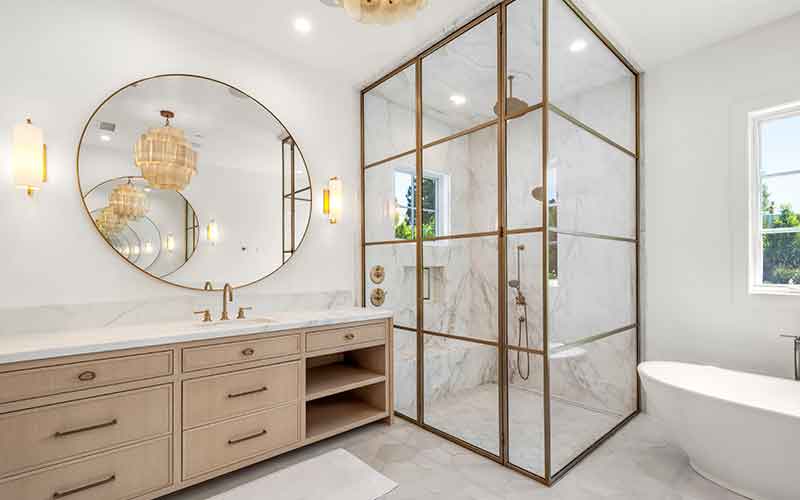
Custom Glass: How Does It Differ from Standard Solutions?
Custom-made solutions are useful when a project requires dimensions, shapes, or configurations that a standard slab cannot provide. This could include a unique niche, a contoured panel, or holes designed for a specific opening mechanism.
For those who assemble and install the unit, customization mainly involves:
- Dimensions and Geometries, to be determined based on the survey and the construction drawings.
- Holes and cutouts, designed for hinges, handles, and fasteners.
- Edge Finishing, which is important for the quality of the component and for the parts that remain visible.
- Sheer Fabrics and Decorations, to be considered based on privacy, style, and maintenance.
Any modifications must be planned before tempering: once tempered, glass cannot be cut or drilled to fit on-site. For this reason, sharing drawings and hardware specifications before production helps prevent incompatibilities and rework.
Dal Bo’ Glassworks: Glassworking for Professionals
Vetreria Dal Bo’ works alongside installers, manufacturers, and retailers to produce glass components for shower enclosures. The company’s contribution involves the glass panels and their fabrication, which must be coordinated with the assembly system specified by the customer.
Our expertise in glass processing, edge grinding, drilling with CNC machines, and sandblasting for decoration are concrete resources for developing custom components. The feasibility of each specific process is evaluated based on the project.
For a professional, this means being able to consult directly with those who work with glass, clarifying the component’s requirements before starting production.
Do you have a supply contract to develop? Send us your drawings, measurements, quantities, and hardware specifications: we’ll assess the work required to prepare a quote tailored to your project.